
The Cassandra of Paris
When the Greeks pretended to sail away and left their giant wooden horse at the gates of Troy, Cassandra, a Trojan priestess warned her people of the trap. She begged them to destroy it, foreseeing with terrifying clarity that dragging it through the city walls would mean the end of everything they had built. The Trojans ignored her warnings, wheeled the horse inside, and celebrated their apparent victory – and by nightfall, Troy lay in ashes.
Knowing the story it’s easy to mock the Trojans. How could they not see the trap? Yet history repeatedly produces its own Cassandras – voices who warn clearly and are ignored until the horse is already inside the walls.
In 1966, French president Charles de Gaulle was Europe’s Cassandra. That year, de Gaulle shocked the Western world by withdrawing France from NATO’s integrated military command. France would remain in the alliance, but not under American military authority.
His reasoning was simple: no American president would trade Chicago for Paris.
Security guarantees feel reassuring in peacetime. In a crisis, they are only as real as the risk someone is willing to take for you. De Gaulle concluded that security could not be borrowed. It had to be owned.
Today, his logic seems almost impossible to argue with. In 1966, it provoked outrage. When de Gaulle ordered all American military forces to leave French soil, U.S. President Lyndon Johnson took it as a personal affront – a slap from a man who seemed to have forgotten the American blood spilled to liberate France in World War II.
The other fourteen NATO members never seriously engaged with his argument. They simply rebuilt the alliance around him and moved on, treating his concerns as a bureaucratic inconvenience rather than a warning about the future of Western security.
For sixty years, that logic appeared to hold… And then the horse came through the gates.
When the Gates Broke Open
Europe’s comfortable illusion did not crack with a grand speech or dramatic election, but during a few quiet days in March 2025 when the United States briefly stopped sharing battlefield intelligence with Ukraine. Kyiv’s forces suffered immediate setbacks on the front line. The outage lasted only days, but the message that rippled through European capitals lasted far longer: Washington was no longer a dependable military partner. Europe needed a plan B.
For the first time since the Cold War, European governments began serious conversations about building their own nuclear deterrent. In February 2026, German Chancellor Friedrich Merz confirmed at the Munich Security Conference that he had begun confidential discussions with the French president on a European nuclear umbrella. “We will not allow zones of differing security to emerge in Europe,” he said. It was a remarkable statement from the leader of a country that since World War II had avoided military ambition.
A Continent Defenceless
To understand why Europe is scrambling, look at the chart below. Russia’s nuclear arsenal dwarfs everyone else’s. The United States is the only country that comes close. And then there is a long, sobering drop-off to the rest of the world.
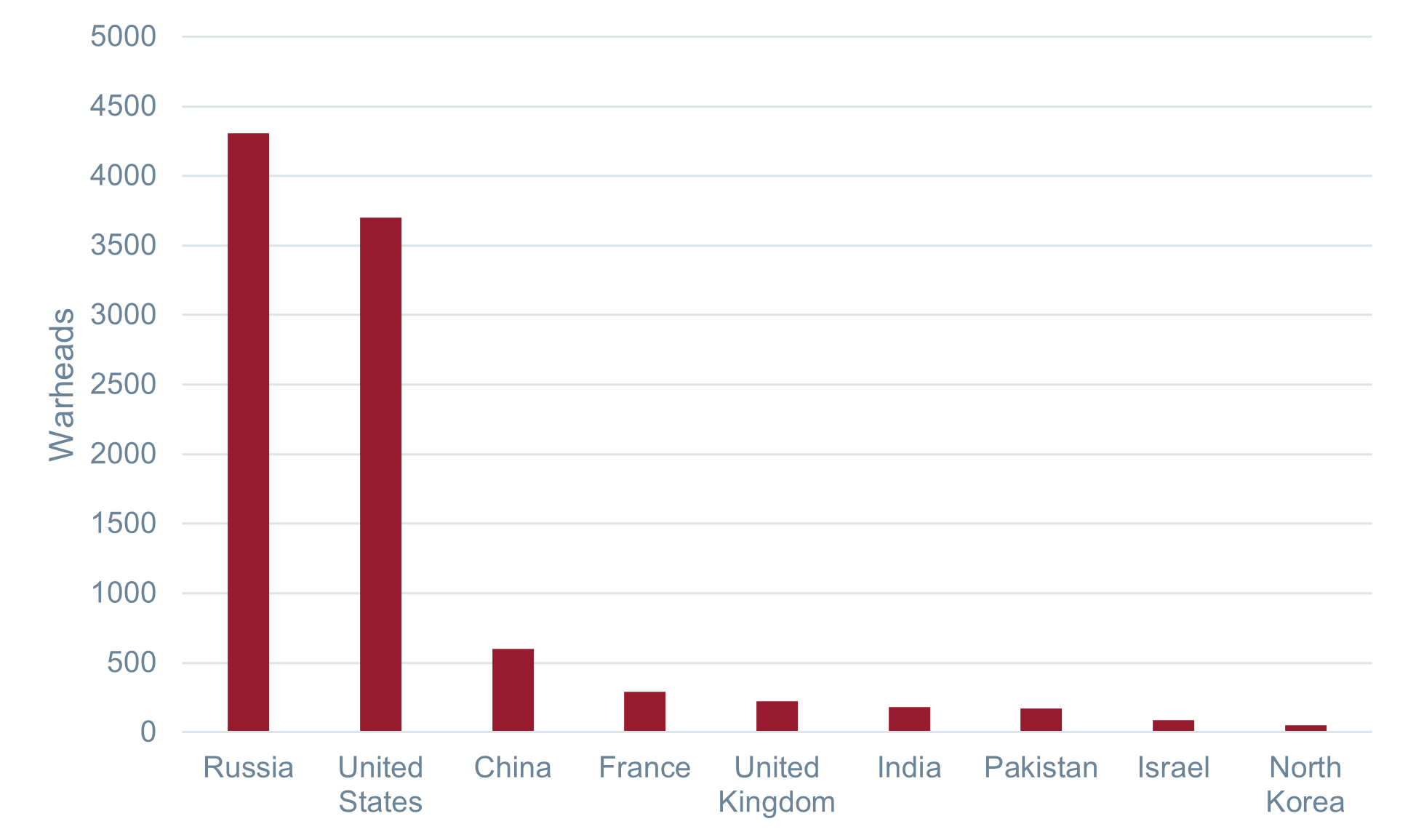
For Europe, the entire continent’s nuclear capability rests on just two countries - France and the United Kingdom. Together they hold around 400 deployed warheads. Though London has operational independence, in theory its deterrent relies on American hardware and supply chains. If Washington steps back, Britain’s nuclear shield weakens precisely when it matters most.
That leaves France as the only country in Europe capable of launching a nuclear response without American permission. One country standing between a continent of 450 million people and the world’s largest nuclear arsenal. And Germany, Europe’s largest economy, now pushing hardest to rebuild its military with zero warheads. Not one.
The Price of Autonomy
Just this month (2 March 2026), standing in front of a nuclear-powered ballistic missile submarine, French president Emmanuel Macron delivered the speech de Gaulle might have written himself. He announced an increase in France’s nuclear warhead stockpile and formally launched a “forward deterrence” strategy: extending France’s nuclear umbrella to eight European partners including Germany, Poland, the Netherlands, Belgium, Sweden, Denmark, Greece and the UK.
In exchange, France requires absolute control. There is no shared button; Paris alone retains the ultimate authority to launch. Furthermore, partner nations must finally pay the price of true strategic autonomy: drastically increasing their defence budgets. Europe’s security is no longer a subsidised American import – just as de Gaulle warned sixty years ago, it must finally be an owned asset.
Critics, however, are already circling. Defence officials across NATO have warned that relying on a French-led umbrella risks fracturing the alliance and tying Europe's survival to the volatile swings of French domestic politics. Furthermore, true independence carries a staggering price tag. While Paris is expanding its arsenal, experts warn that building a fully self-sufficient European defence architecture to replace American protection could require an additional €250 billion in annual defence spending across the continent – a heavy bill that has left many questioning whether Europe can actually afford to turn Macron's grand vision into reality.
Yet, this is the exact reality de Gaulle foresaw. He spent a decade being called a relic for demanding it. Like Cassandra, he saw what was coming with uncomfortable clarity. But unlike Cassandra, he actually did something about it.
Today, Europe is finally doing something about it, too. They are moving sixty years late, considerably over budget, and with the ruins of a very comfortable illusion still smouldering at their feet.
The horse, it turns out, was always there. They just chose not to look.