The market has become increasingly comfortable with the idea that the SARB is done hiking. Most forecasts show inflation moving back towards 3% during 2027 as the impact of higher oil prices fades and with economic growth still weak, there is an understandable temptation to conclude that the next move in rates will eventually be lower.
That may still prove correct, but I think the decision is becoming more complicated than the consensus suggests. The starting point is the change in South Africa’s inflation framework. In July last year the SARB began explicitly aiming for 3% inflation, with the new target subsequently formalised at 3% with a tolerance band of one percentage point either side. At the time, the transition looked relatively painless. Inflation was already close to 3%, the rand was supportive and there was a reasonable chance that inflation expectations would gradually adjust lower without the Bank having to impose materially tighter monetary policy.
A year later, the picture looks rather different. Headline inflation has come back from its recent peak, falling from 5.0% in June to 4.3% in July, while goods inflation declined to 3.4%. This is obviously encouraging and supports the view that the inflation shock is not becoming completely unanchored. The problem is that the headline number hides a fairly uncomfortable divergence between goods and services.
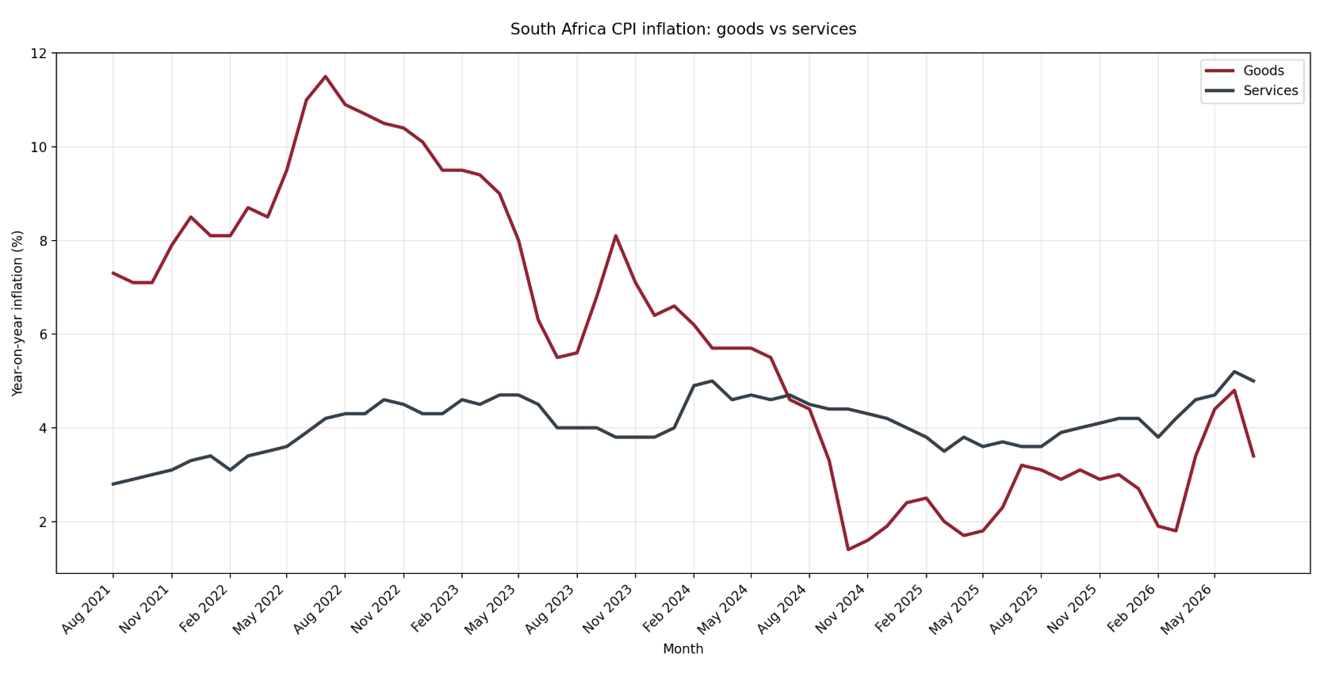
Services inflation is still running at around 5%. That matters because the SARB can reasonably argue that it should look through the first-round effect of an oil shock. Higher interest rates cannot lower the global oil price and, in any event, higher fuel costs already act as a tax on household disposable income. Tightening aggressively simply because petrol prices have risen would risk doing unnecessary damage to an already weak economy.
It becomes much harder to make the same argument about services inflation. Prices such as insurance, housing-related costs and a range of other domestic services tend to be stickier and tell us far more about underlying price-setting behaviour. If South Africa is genuinely moving towards a 3% inflation regime, services inflation ultimately has to move in that direction as well. So far it hasn’t.
This is probably the most important distinction in the current debate. The consensus may well be right that headline CPI gets closer to 3% next year, particularly once the oil base effects start working in our favour. But getting headline inflation temporarily back to 3% because oil falls out of the calculation is not the same thing as establishing a sustainable 3% inflation environment. The latter requires businesses, workers and consumers to start behaving as if 3% is the new normal and services inflation at 5% suggests that process still has some way to go.
Food inflation introduces another risk which is perhaps being underestimated. Food and non-alcoholic beverage inflation was only 0.9% in July, providing an unusually helpful offset to higher fuel and services inflation. From such a low base, there is very little room for food to surprise positively. Even a fairly benign normalisation towards 3% or 4% would make headline inflation more difficult to bring down.
The concern is that this normalisation could coincide with El Niño. A hotter and drier summer across parts of South Africa’s summer rainfall region would create an obvious risk to agricultural production and food prices next year. It is far too early to assume a serious food shock, but the asymmetry is worth noting. Food inflation is currently doing a lot of work in keeping the headline number contained, while oil remains elevated and services inflation is stubborn. If food turns at the same time, the inflation mix becomes considerably less comfortable.
This is where the SARB’s credibility becomes important.
When the Bank moved towards a 3% target, it effectively gave itself around two years to establish the new regime. Monetary policy also works with a substantial lag, which means the SARB cannot wait until late 2027 to discover that inflation expectations and domestic price-setting never really adjusted. At some point the forecast needs to be confirmed by the underlying data.
The distinction between the old and new frameworks also matters more than many investors appreciate. Under the old 3-6% range, inflation around 4% would have been comfortably acceptable. Under the new framework, 3% is the target and 2-4% is a tolerance band. The Bank has been quite deliberate in making clear that it is not indifferent between inflation at 3% and inflation at 4%.
My base case is still that the SARB holds rates in September. July’s inflation data improved enough to justify waiting for more evidence and the economy is hardly in a position where the MPC needs to restrain excessive demand. But I would be careful about assuming that a hold means the hiking cycle is definitively over.
If oil moderates, services inflation starts moving lower and food inflation remains contained, the Bank can sit tight and eventually begin considering cuts again. If, however, services remain around 5%, food inflation starts rising and oil continues to keep headline inflation elevated, the debate changes quite quickly. In that scenario, another 25 basis point hike would not be particularly surprising.
The real test of a new inflation target was never going to come when inflation was already at 3%. It was always going to come when defending that target became inconvenient. The SARB may ultimately decide that the current shocks are temporary and do nothing, but with services inflation still far from target and food risks moving in the wrong direction, its room to simply wait is getting narrower.
For now, I think cuts are off the table. The next move is probably a hold, but the risk is increasingly that the move after that is a hike rather than the beginning of another easing cycle.